PETROLEUM
The Company’s business activities related to fuel is in the form of distribution and not production, so there is no production process, or data related to production capacity, to be reported by the Company.
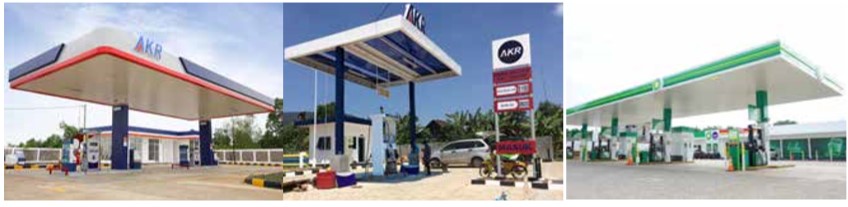
The Company distributes three types of petroleum, which are retail subsidized petroleum )diesel) with quotas regulated by the Oil and Gas Downstream Regulatory Agency )BPH Migas), retail non-subsidized petroleum, and industrial non-subsidized petroleum. Subsidized petroleum is distributed to motorists and fisheries, while industrial non-subsidized petroleum is distributed to meet the demand from industrial, commercial, mining, power, fishery, bunkers, etc. Based on customer segment, AKR petroleum is divided into industrial petroleum and retail petroleum, in which subsidized petroleum included in retail petroleum category. In 2017, the Company and BP Global have established a JV to develop non-subsidized retail petroleum in Indonesia. The JV company has successfully launched the first BP-AKR petrol stations in De Latinos, Serpong in November 2018, and followed by second station in Jababeka. A groundbreaking in Surabaya, East Java was also held on 18th October 2018.Going forward, the company expects to open more retail outlets in Indonesia, with an initial focus on large cities to open more retail outlets in 2019, with an initial focus on large cities like Jabodetabek, Bandung and Surabaya.
In the retail segment, the Company has been entrusted by the Government for 8 consecutive years to distribute certain type of subsidized fuel. Based on decision in November 2017, BPH Migas has assigned AKRA as as a P3JBT agent for five years to distribute subsidized diesel for the period of 2018-2022. For 2018, the Company received quota to distribute 250,000 KL of diesel fuel in Indonesia. There are also changes in terms of gasoline market, in which consumers consumption has been shifting from the subsidized-low-octane gasoline to the nonsubsidized-high-octane-gasoline. We see higher gowth is seen in the non-subsidized high-octane gasoline. On the other hand, consumption of low-octane gasoline has been declining in the recent years. That encouraged AKR to introduce AKRA 92 gasoline products in 2016 and to further develop its retail fuel business through partnership with BP.
Following the declining world oil prices that occurred since 2014 and continued into 2015, world oil prices began to rise since 2016 and kept increasing during 2018. This resulted in a positive impact on the selling price. Towards the end of 2018, Ministry of Energy and Mineral Resources announced the mandatory use of Biodiesel )B20 policy) for all industrial and transportation users with limited exceptions. Government trusted AKR with the largest quota of FAME )Fatty Acid Methyl Ester) allocation amongst private companies.
As a distributor of petroleum products across the Indonesian archipelago, the Company has developed a robust business model whereby the company has efficient mechanisms to overcome economic fluctuations, where changes in world oil prices and currency exchange rate fluctuations can be passed through to customers. The Company has a prudent risk management system and manages the net open position effectively.
PETROLEUM SALES
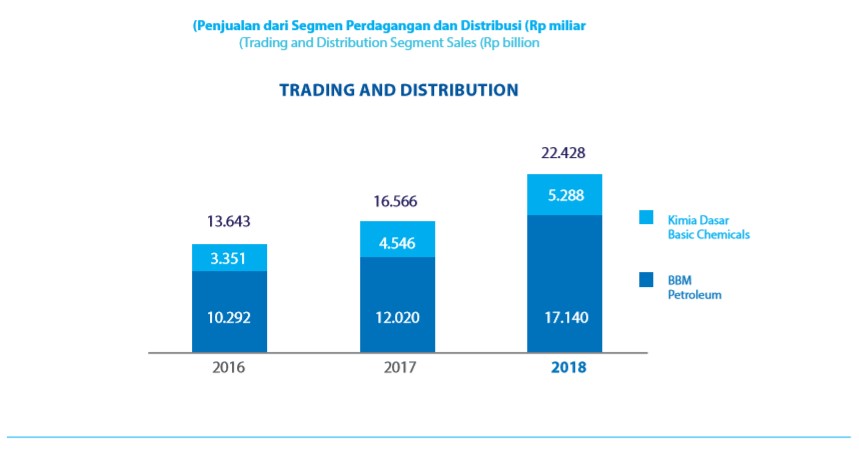
The Company’s fuel sales grew from Rp12,020.3 billion last year to Rp17,140.9 billion in 2018, higher by 42.6%. During 2018, the Company implemented more prudent risk management, and became more selective in terms of customers, based on customer business risk. The volume to mining customers recorded 18% growth, while from power sector grew by 27%. In the retail segment, the Company recorded 18% growth. Overall, the Company recorded 8% growth in volume and a significant growth in selling prices. The contribution of petroleum distribution to the Company’s consolidated sales and revenues reached 72.8% in 2018.
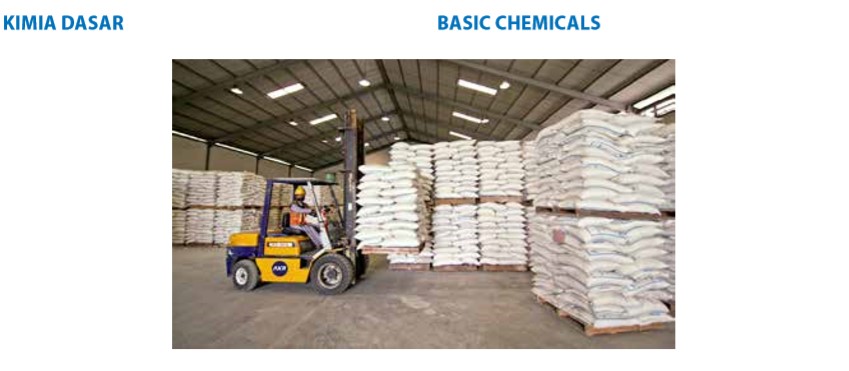
The Company’s basic chemicals business is through distribution and trade, so there are no production activities )or data related to production capacity) performed )owned) by the Company. The Company serves as a distributor in Indonesia for domestic and international basic chemical manufacturers. Basic chemical products are the raw materials needed by many industries, such as chemicals, textiles, pulp and paper, consumer goods, fertilizers, plywood and refined wood products, food, pharmaceuticals, alumina, and other industries.
BASIC CHEMICAL SALES
In 2018, chemicals revenue grew by 16 % to Rp5,288 billion. The Company’s main principal increased its capacity by 40% to 700,000 MT in 2017, mostly for Caustic Soda. Indonesia’s GDP also increased from 5.07% to 5.17%. Sustainable growth in manufacturing industry has been key driver for growing basic chemicals business. We saw demand growth from new customers and existing ones in several sectors, notably from smelters and rayon companies.. In general, in 2018 we saw tight supply of basic chemicals products in domestic market due to lower imports, especially from China which currently is addressing some environmental issues related with the manufacturing.
Basic chemical sales contributed 22% to the Company’s consolidated sales and revenues in 2018.
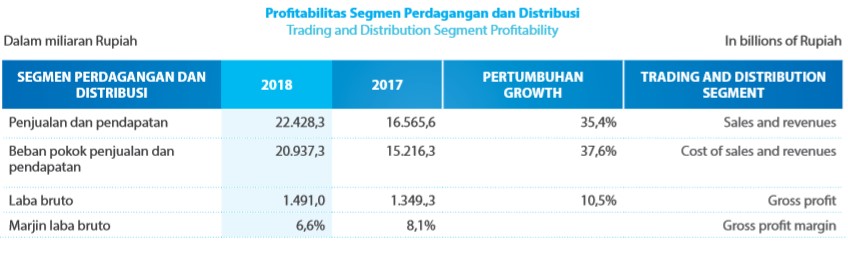
Higher selling prices for both petroleum and chemicals and volume growth improved the gross profit contribution from segment by 10.5%. The company continued to tighten its cost structure and maintain supply chain efficiencies to improve its margins on per unit basis.
MANUFACTURING
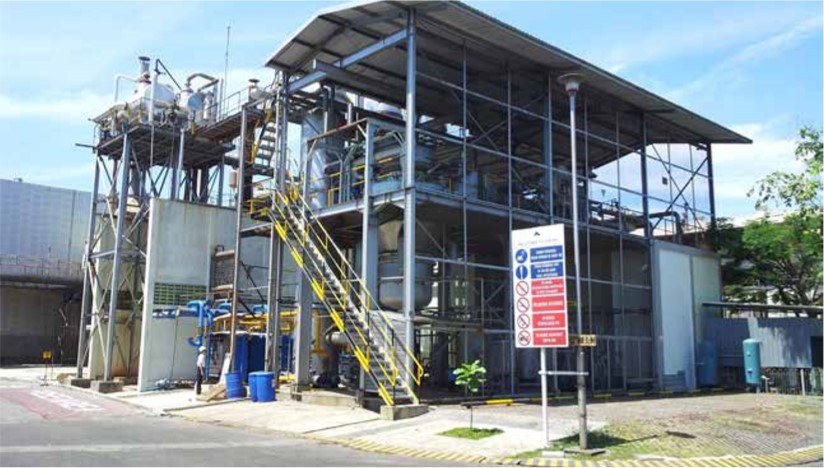
The Company in 2018 only own 1 subsidiaries engaged in the manufacturing business segment, it is PT Arjuna Utama Kimia )Aruki) that produces wood adhesives in Surabaya. Previously, The company had Khalista )Liuzhou) Chemical Industries Ltd )Khalista) that produces sorbitol, flour and derivatives in China.
Khalista stopped its business operations since September 2017, due to the sale of Khalista assets as a follow-up to the State-Owned Land Use Right Repurchase and Compensation
Contract between Khalista )Liuzhou) Chemical Industries Ltd., with the Land Trade and Reserve Center of Liuzhou City, the People’s Government of Yufeng District, Liuzhou City, the Commission of Industry and Information Technology of Liuzhou City and the Bureau of Finance of Liuzhou City )RRC). In accordance with the agreement signed in August 2017, the Company auctioned land through the local government on 27 February 2018 and disposed the assets. All the proceeds related to divestment more received during 2018. The details of proceeds and gains are disclosed in Note 34 of Audited financial statement.
Adhesives
adhesives production
Aruki produces high-quality wood adhesives for the wood and paper industries. Aruki always ensures high quality products and is committed to conducting environmentally friendly business activities by applying the ISO 9001-2015 Quality Management System and ISO 14001-2004 Environment Management System.
Adhesives Production Capacity
Total production capacity in 2018 was equal to 2017 reaching 100,000 MT. There was no additional production capacity during 2018.
Adhesives Sales
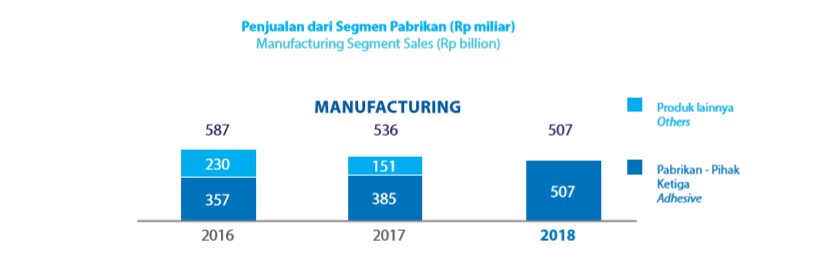
Amid the challenging property market in China due to trade war and economic slowdown in 2018, Aruki sales still increased by 32% from Rp385.0 billion to Rp507.5 billion. Increased oil price also drove selling prices of Aruki’s products higher last year. In terms of volume, the volume of Aruki grew by 15% from 74,036 MT in 2017 to 85,353 MT in 2018.
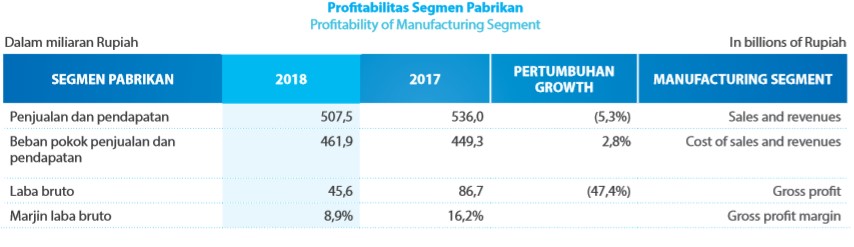
The profitability of adhesive business was stable but since there was no contribution from Sorbitol business anymore, the overall gross profit of the segment fell by 47%.
LOGISTIC SERVICES
The Company provides integrated logistics services to third party customers at major ports in Indonesia. In general, the Company’s logistics services business includes port operations, transportation, storage tanks and warehouse rental, and others.
The Company provides storage tank rental services for liquid bulk products, such as liquid chemicals and Crude Palm Oil )CPO), as well as warehouse rental for storage of dry bulk products, such as dry chemicals, sugar, fertilizer, and animal feed. This rental activity is based on long-term contracts with major customers and suppliers.
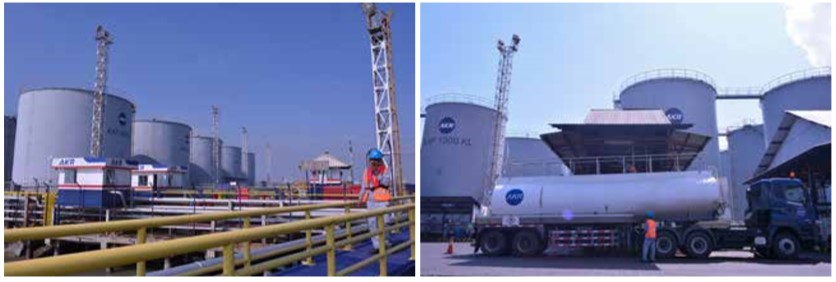
The Company also provides Port handling services, customs clearance services, loading / unloading of goods / containers from vessels using Mobile Harbor Cranes, storage )warehousing) and bagging at ports in Medan, Surabaya, Semarang, Jakarta )Ciwandan and Priok), and transportation services using trucks.
The Company’s subsidiary, PT Jakarta Tank Terminal )JTT), provides rental services for fuel storage tank terminals, with a total capacity of 250,000 cbm in Tanjung Priok, Jakarta. JTT is one of the leading private tank terminals in Indonesia, equipped with jetties and underwater pipelines. The Company together with Vopak started the capacity expansion project on 4th October 2018 to complete by end of 2019. The project is targeting additional of 100,000 cbm storage for gasoline, ethanol and biofuel, so that capacity of JTT will be 350,000 cbm after completion.
The Company also added 2 new vessels during 2018 to its fleet to strengthen its supply chain network. The Company has divested its port operations in China in 2017 and no longer provides any logistic services in China.
Logistics Infrastructure Capacity
The logistics infrastructure capacity in Indonesia is presented in detail in the Logistics Infrastructure Network section at the beginning of this annual report.
LOGISTIC SERVICES SEMENT REVENUE
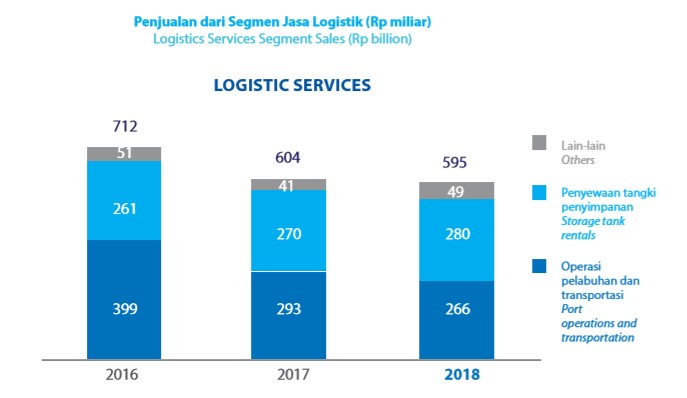
Revenue from the logistics segment in 2018 reduced slightly by 1.6% from Rp604.4 billion in 2017 to Rp594.7 billion in 2018. This decline was due to the sale of the Guigang port in China in 2017. Revenues from Guigang logistics were still recorded in 2017. The China operations contributed to the segment until May 2017 whereas there was no contribution in 2018.
The Company also reduced its handling activities at Surabaya port to focus more at its port in JIIPE. Accordingly, gross profit also declined by 42.7% to Rp53.9 billion.

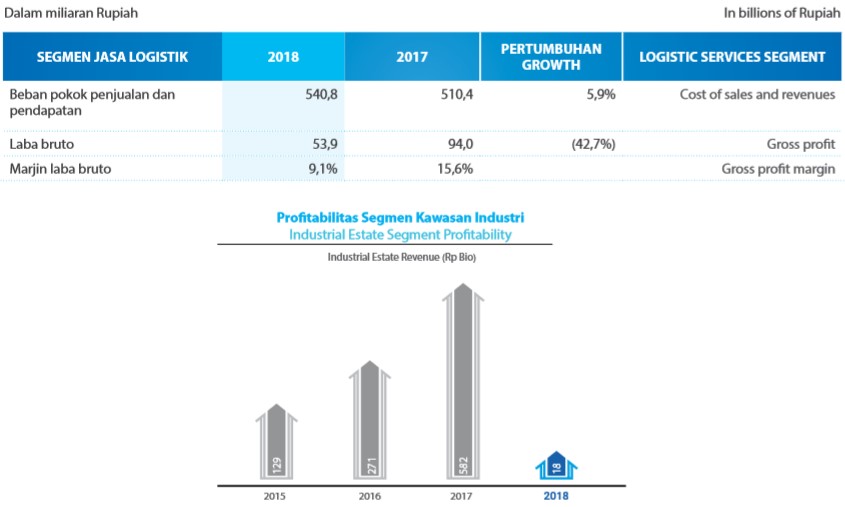
In 2018, revenues came mainly from utility services whereas 2017 also included revenue from the sale of industrial land. With the absence of industrial land sales and higher costs in 2018, the segment recorded negative gross profit during 2018.
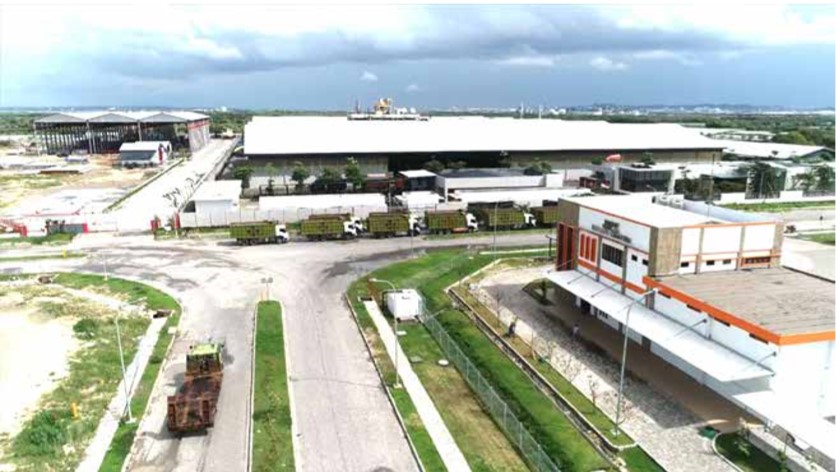
JIIPE is the first leading integrated estate in Indonesia with total area of 3,000 hectares, consisting of industrial estate with logistics center and bonded facilities, multipurpose port for international and inter-islands connectivity, supported by commercial and residential township. Located in Gresik, East Java Province, JIIPE will be a leadingstrategic industrial hub in Indonesia and Asia Pasific.
Since the JIIPE Estate construction first commenced in November 2013 until now, the Company has continued to accelerate the process of providing land and supporting infrastructure, to bolster the investment development in East Java, and Gresik in particular.
The Phase I infrastructure development has been completed. The development included;
- Operation of first stage 23 MW power plant.
- 9 Km Access road to the port area.
- Gas pipeline is already connected to First Multipurpose Block and Clean Block, with State-owned Gas Company )PGN) as the first supplier.
- Telecommunications systems with fiber optics and broadband internet,
- 1st stage Water Treatment Plant using Sea Water Reverse Osmosis system with capacity 100m3/hour, operational in Q1 2019.
- 1st stage Waste Water Treatment Plant with capacity 2500m3/day, operational in 2019 80 Ha port estate
- Port operations has handled cargo since 2016
The industrial estate development in 2018
Java Integrated Industrial and Ports Estate )JIIPE), the largest and the first integrated industrial estate in East Java and in Indonesia, which integrates ports, industries, and residences, as well as connected by highway and railway network, was officially inaugurated by the President of Republic Indonesia, H.E. Joko Widodo, on March 9th 2018, in Gresik-East Java. JIIPE was also designated as National Strategic Project by The Government.
JIIPE is located in Gresik City, only 24 km from Surabaya, the economic and investment center of East Java. JIIPE’s existence is targeted to save on logistics costs with connectivity to domestic and foreign markets through various facilities and infrastructure built to international standards.
In 2018, JIIPE changed its logo which delivers brand of ‘Confident Futures’. The wordmark is bold, solid and simple, communicating the confidence of JIIPE business. The symbol of the interconnected rings represents the commitment in creating a truly integrated development that progresses society.
a. Investors / Tenants
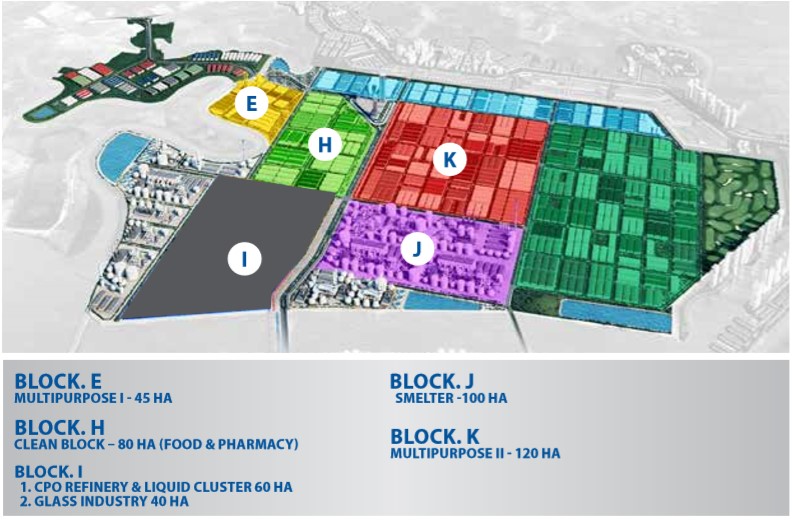
- 3 from 8 tenants have already commenced operation, while 2 tenants are under construction. They are coming from different industries including chemicals, food and fertilizer.
- JIIPE has applied a clustering system to ensure business continuity and synergy for companies in the Industrial Zones, where the location for investors will go through a screening phase to minimize any contradictory impact of inter-tenant operations. Six )6) companies have occupied 1 )one) block in the JIIPE Estate, i.e. in the Multipurpose Cluster, and 2 companies have occupied the Clean Block Cluster for the food, pharmaceutical and manufacturing industry sectors that require a clean area.
- JIIPE plans to open a Liquid Cluster equipped with pipe rack to liquid jetty, to accommodate the liquid-based industry sector needs; The Multipurpose Stage 2 cluster will be an ideal destination for diverse manufacturers who need complete utility supplies; and the Smelter Cluster will be equipped with facilities to support metal purification activities.
b. Utilies
- The JIIPE focus in 2017-2018 had been the development of independent utility facilities to support the tenant’s operations, including power generation, water supply, waste management, gas pipeline connections, and telecommunication systems using fiber optic networks.
- A 23 MW power plant has been supplying industrial tenants since November 2017. The power plant uses a ring loop distribution and double feeder system to minimize power supply interruptions to the tenant areas. The total electricity capacity in JIIPE will reach 1,183 MW, and will be developed in 3 stages to ensure the availability of quality supplies at competitive rates.
- The clean water management facility first phase is planned to be completed in 2018, using a “Sea Water Reverse Osmosis” desalination system, with a capacity of 2400 m3/day. To accommodate industries that require clean water supplies in their production processes, JIIPE will obtain clean water supplies from Bendung Gerak Sembayat at a rate of 1000 liters/ second, and will begin in 2020.
- Waste Water Treatment Plant began the construction in August 2018 and planned to commissioning in April 2019 with capacity 2,500 m3/day. The Waste Water Treatment Plant using Membrane Bio Reactor technology that can ensure wastewater effluent meet quality standards of Government regulation with minimal use of land and time. The effluent also reprocessed in Ultra Filtration and Reserve Osmosis unit to produce clean water for tenants and minimize natural extraction of natural water resources.
- In 2017 JIIPE also completed the phase 1 construction of a gas pipeline, from the regional gateway to the Multipurpose Cluster, where National Gas Company )Perusahaan Gas Negara) was the first gas suppliers to deliver natural gas into the area in 2018.
- – In addition, two leading telecommunication service providers in Indonesia have collaborated with JIIPE to provide telecommunication networks and fiber opticbased broadband Internet.
c. InfrastructurE
- The 9 km access road connecting the industrial and port areas was completed in mid 2015 and supported the loading and unloading logistics activities on the pier, and currently serves dry bulk and general cargo. After being declared as National Strategic Project in 2017, JIIPE expects more supports from government, both central and local, to accelerate the supporting infrastructure development, such as: )1) The 39 km toll road access from Krian direct to JIIPE )KLBM-Krian Legundi Bunder Manyar toll road project), which is expected to start operation by the end of 2019; )2) Plan to develop the double track train facility connecting JIIPE to Duduk Sampeyan Train Station )on the border of Gresik-Lamongan), over a distance of 11 km )part of Trans Java rail network).
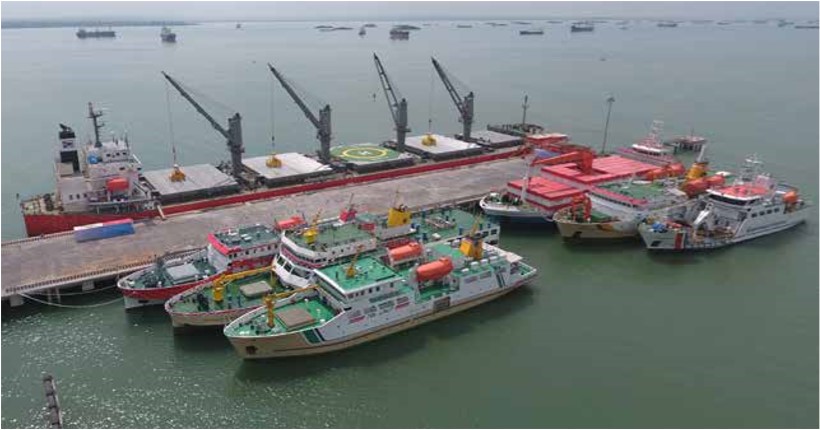
JIIPE port has been serving ships and cargo since it received a port operation permit at the end of 2015 and completed the first jetty with the 500 meter dock area. Since December 2017 BMS also has been granted concessions from the Ministry of
Transport to undertake port services for the Manyar Terminal in Gresik Port, East Java for 76 years. The volume of bulk products handled in the JIIPE port reached 1.05 million MT in 2018, mostly for wheat, fertilizer, rock salt, bentonite, and soda ash.
In 2018, 250 m x 30 m existing jetty operated 2-side function for loading and unloading. It is already utilized for dry bulk and general cargo. It has natural draught -14 LWS and had reach vessel for capacity of 60,000 DWT, currently we also plan to develop the second jetty soon.
The Central and local government is very supportive to the development of JIIPE. In addition to support that allows for accelerating the infrastructure development, government also includes JIIPE as Industrial Estate and Bonded Logistic Center to participate in “KLIK” program; Direct Construction Permits, Online Single Submission )OSS), where investors can directly build their plant simultaneously with obtaining their building permit )IMB), so that saving time and cost.