

FINANCIAL AND OPERATIONAL CONTROL SYSTEM
The Company’s financial control system is implemented by providing financial information to all levels of management, shareholders, and stakeholders, for them to base their economic decisions. This system is used by management to plan and control the Company’s operations.
Meanwhile, the operational control system has implemented policies and procedures that are directly used to achieve the goals and targets, to ensure or provide appropriate financial reports, and to ensure compliance with laws and regulations.
INTERNAL CONTROL SYSTEM FRAMEWORK
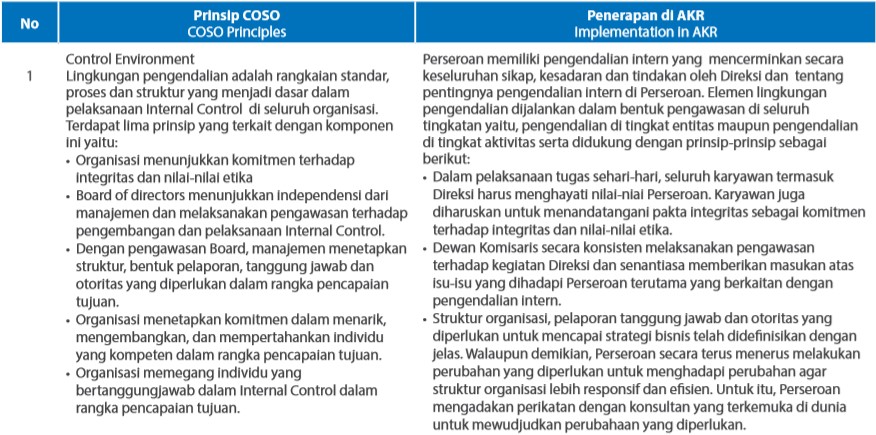
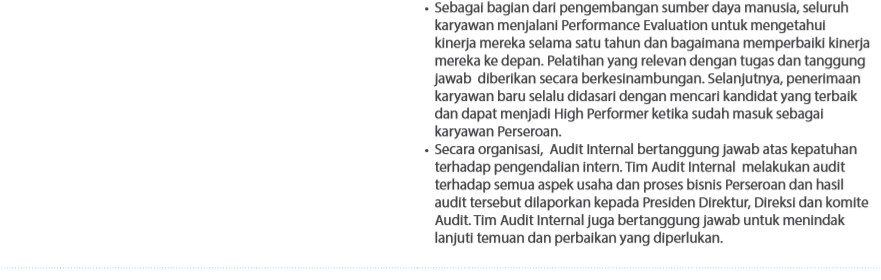
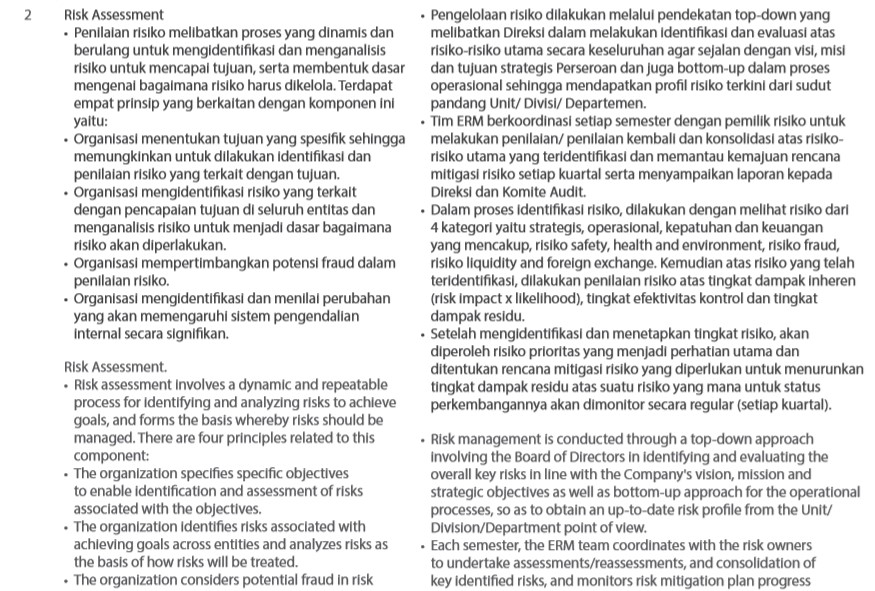
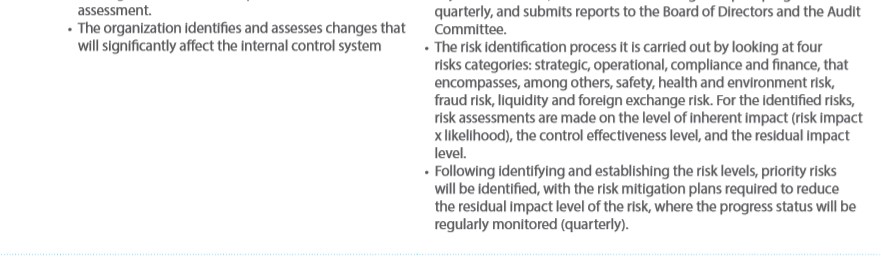
The Company has an internal control system that aligns with the internationally recognized framework, namely the Committee of Sponsoring Organizations of the Treadway Commission (COSO). Based on COSO, the internal control system is a process that involves the Board of Commissioners, the Board of Directors, as well as other personnel. This is in line with the internal control system in the Company, which continuously improves the organizational control system by managing all available resources.
The Company believes that the internal control system should aim to provide reasonable assurances for the achievement of the following three objectives:
- Operational effectiveness and efficiency
- Financial reporting reliability
- Compliance with laws and regulations.
The Company views internal control as a part of a chain of activities that covers the Company’s entire business processes. Internal control can be found in the basic management processes such as planning, implementation, and monitoring. The internal control system components include the following:
- Control environment that includes integrity, ethical values, and competencies of people and entity, management philosophy and style of operation, the way management hands over authority and responsibility as well as organizing and developing its business in accordance with management directions.
- Risk assessment that aims to identify, analyze, and manage the risks associated with the Company’s many business activities.
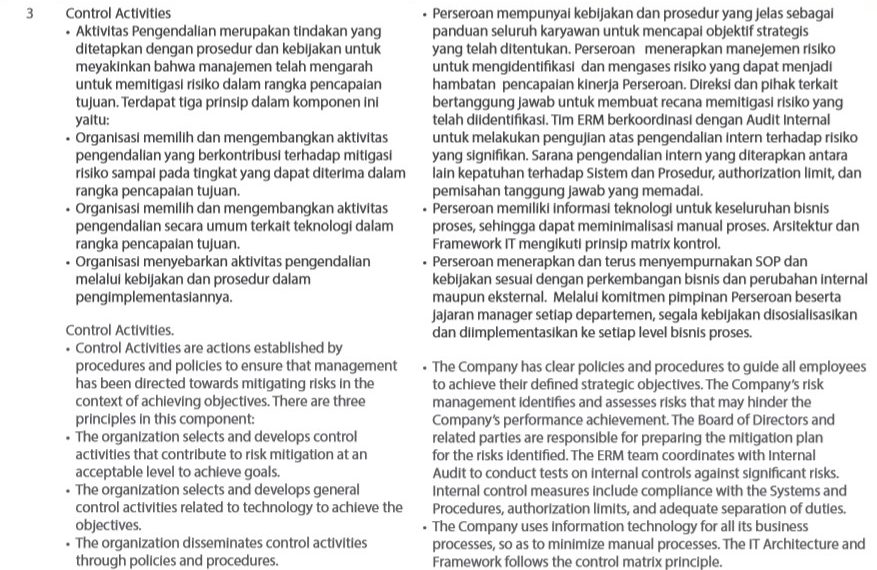
- Control activities that are continuously performed to determine the policies and procedures that are established by management to ensure that the Company’s business objectives have been reached.
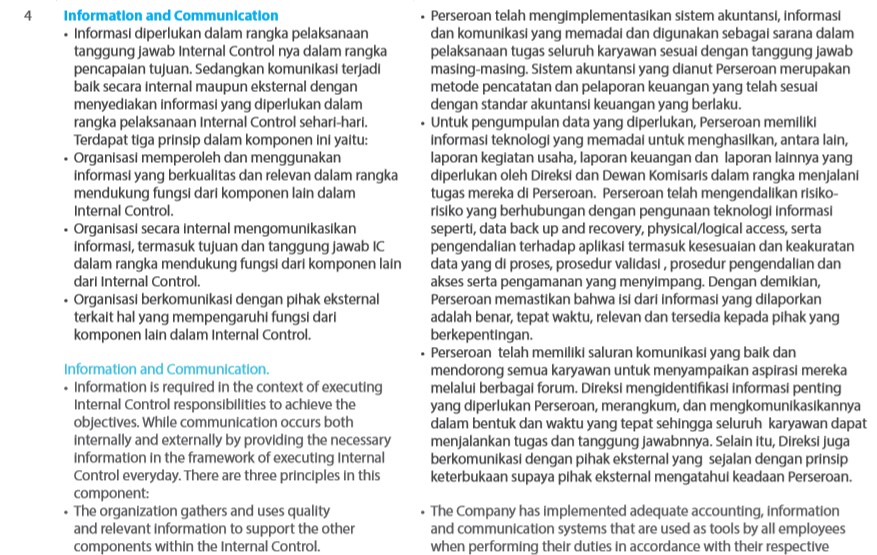
- Information and communication that allows any person or entity, to obtain and exchange the necessary information to implement, manage, and control the Company’s operations.
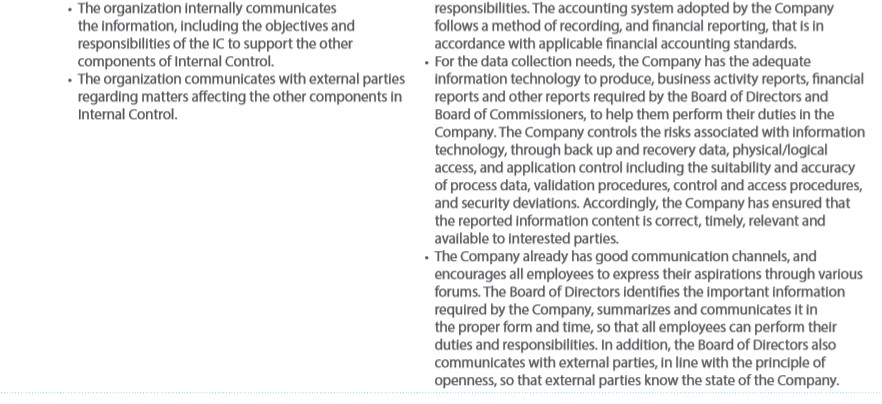
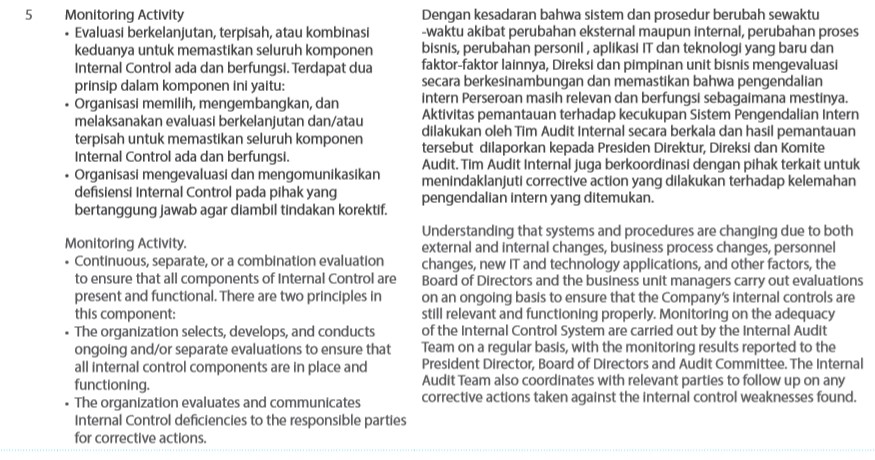
- Monitoring that aims to assess the quality of Company’s performance, conducted through continuous monitoring, separate evaluations or a combination of both.
Compliance with COSO standards


EVALUATION OF INTERNAL CONTROL SYSTEM EFFECTIVINESS
Efektifitas sistem pengendalian internal Perseroan tercermin dalam tiga proses yaitu:
The Company’s internal control system effectiveness is reflected in three processes, namely:
1. Entity level process The realization of the increase in internal control can be seen at the entity level. The Company’s Internal Audit Unit continuously strives to improve the quality of its audit control and inspection of all departments, branches and projects’ performance. The company immediately follows up any criticisms and suggestions made to the Company, so that all employees at all levels can contribute by taking part in monitoring and reporting any dishonesty in any work areas of the Company. To maintain the commitment to the Company’s corporate governance implementation, the Company has implemented code of ethics’ principles at all levels.
2. Business level process The increased scope of internal control at the business level processes has had an impact on the financial reports, especially from a risk identification aspect, which can now be made more accurately and accountably. This is evident from the internal controls on the procurement, financial reporting, sales and accounts receivable processes.
3. Information Technology level process
- Improvement of network and security systems;
- Improvement in the quality of information technology